

Character: The CEO Advantage That Outlasts Talent, Technology & AI

Why Character Matters More Than Personality
I want to start with a simple conviction: Character is the single most powerful lever a CEO has. Not personality. Not raw intelligence. Not even the latest tool or technology. Character determines whether you will persist through adversity, make the right calls when under pressure, and earn the kind of trust that creates momentum across an organization.
I say this from a mixture of observation, research, and lived experience. Over the last four years I’ve dug deep into personality science and leadership performance, and what keeps surfacing is that leaders with strong Character consistently outperform those who rely on personality alone. If you’re running a company, leading a team, or planning your next big move, understanding and developing Character should be your priority.
A Personal Rehab Conversation
A close friend of mine came back from rehab and shared something that confirmed our training. He described how their program taught the difference between biology and choice. Addiction, he explained, has a very biological component. Your body craves substances. Your nervous system learns patterns that pull you back.
But what the clinic trained people to do was step above that biology through developing Character . They practiced creating a space between impulse and action, and then choosing a different response. That gap is where Character lives. It is the ability to choose deliberately rather than to be driven automatically. For leaders, that ability is priceless.
The Military Lesson That Made Character Non-Negotiable
My grandfather was in the British Indian Army. He was a man of strict principles and deep spirituality. He taught me that being a person of your word and holding to values matters more than any tactical success. He modeled how Character shows up in daily commitments, not just grand speeches.
That upbringing made Character a baseline for me. When I reflect on times I underperformed, it was rarely a lack of skill. It was when my behavior drifted away from the values I claimed to hold. Restoring alignment between values and action repaired everything else.
Personality Versus Character: The Distinction That Changes How You Lead
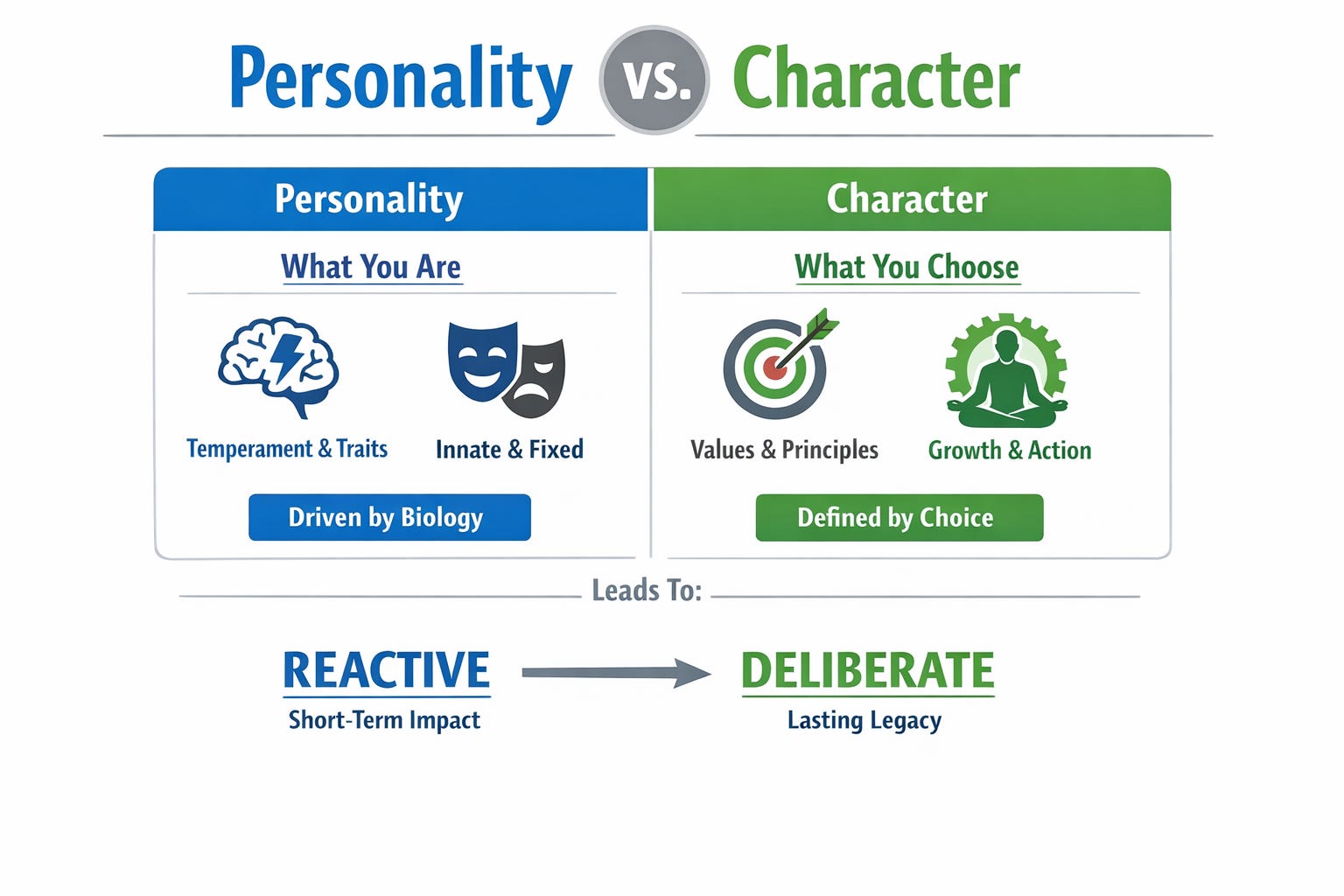
Leaders often conflate personality with Character . Personality is visible and stable, yes, but it is not destiny. Let me break down the two cleanly so you can see why investing in Character gives a higher return.
What Personality Is
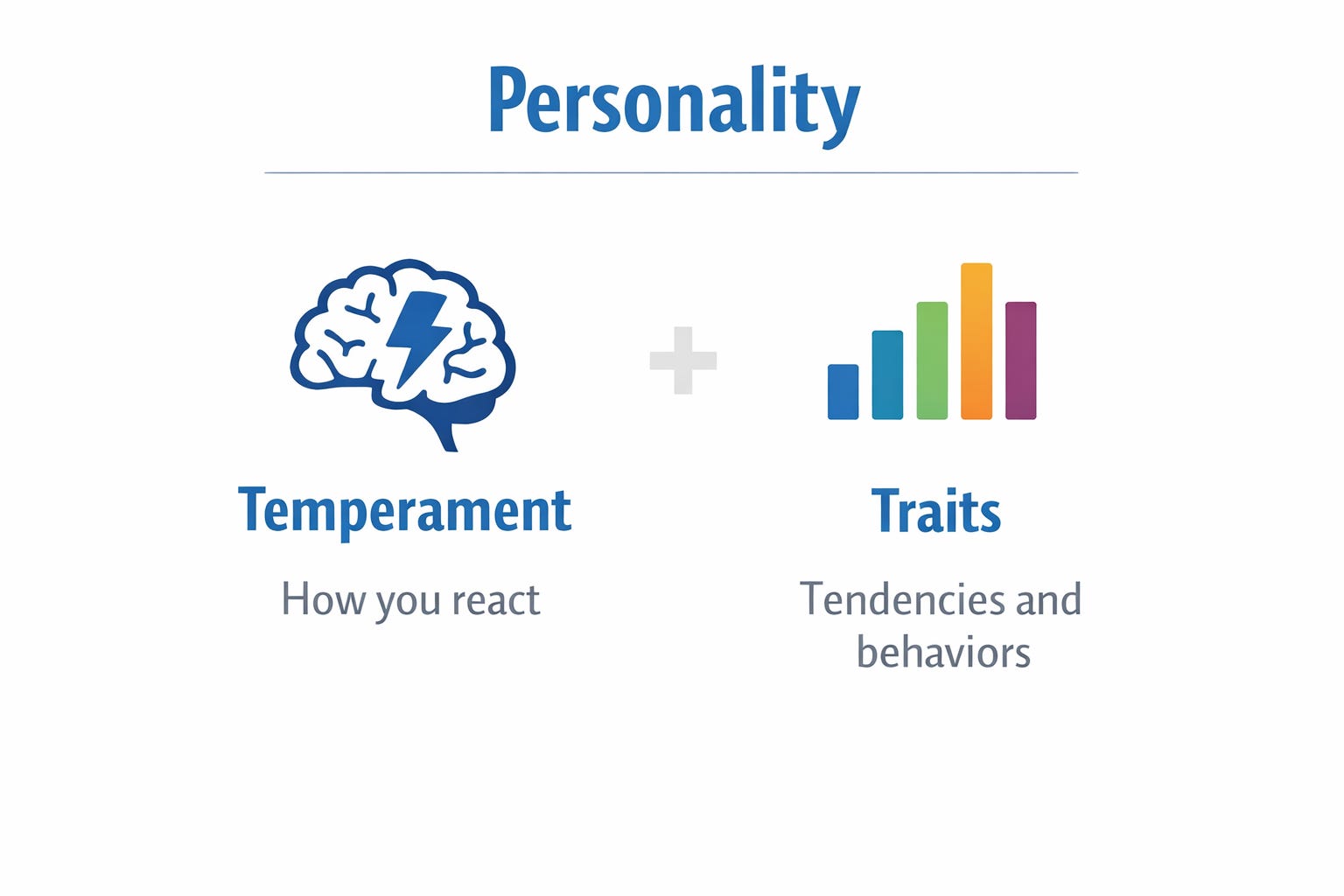
Personality consists of a predictable pattern of thoughts, emotions, and behaviors. Two components dominate:
· Temperament — the biological wiring of how you react. It is influenced by genetics and early environment. It explains why some people are inherently calm under fire and others flare up quickly.
· Traits — the measurable tendencies we talk about in psychology, like openness, conscientiousness, extroversion, agreeableness, and neuroticism. There is also a growing recognition of humility as a sixth trait.
Personality is useful to understand because it explains predictable reactions. But it also has limits. Temperament is hard to shift overnight. That is why leaders who lean only on personality often plateau.
What Character Is
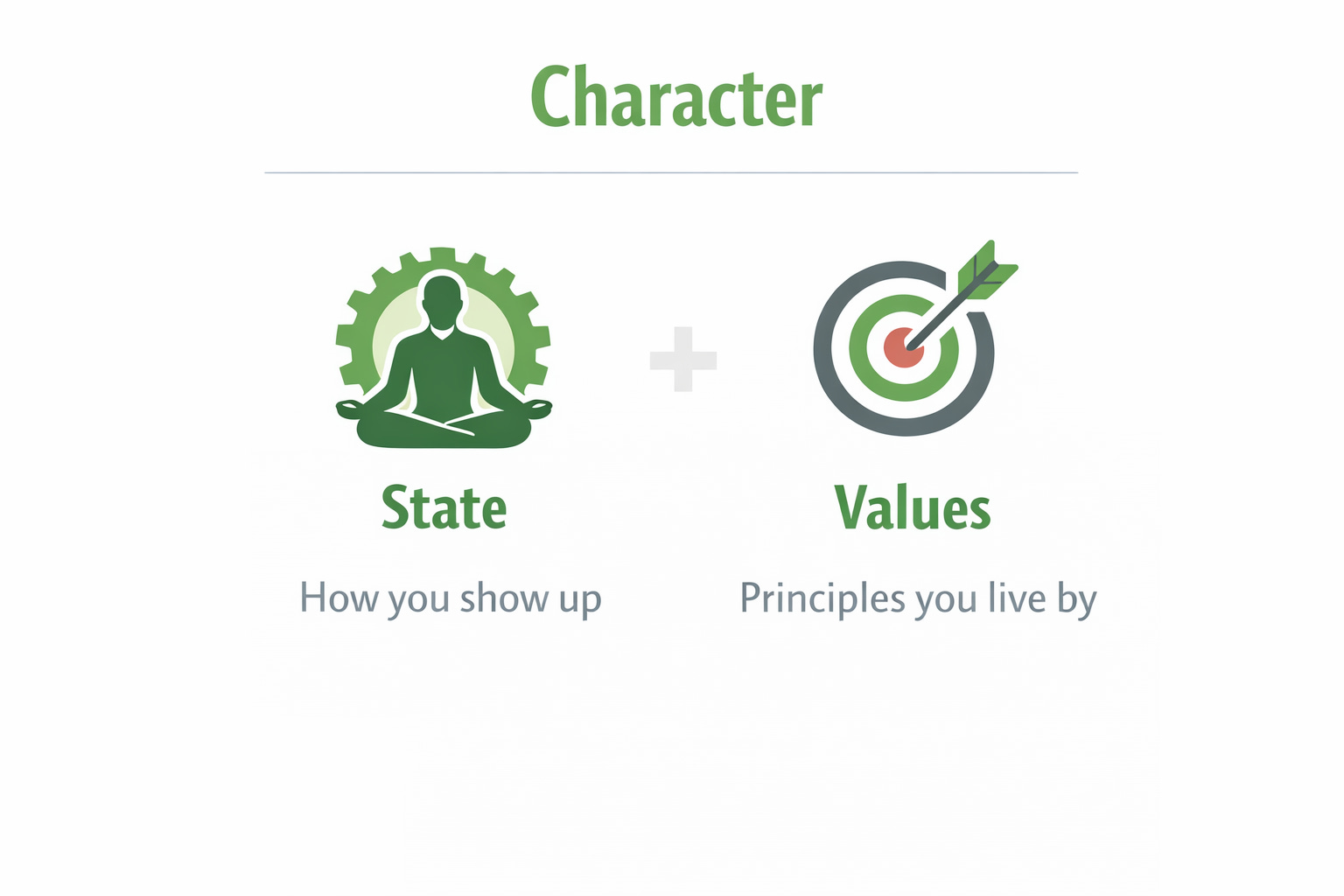
Character is different. It is not a static label you inherit. It is made, not merely given. In my framework, Character is built from two actionable pillars:
· State — how you show up in each moment. This includes your focus, your energy, your mindset, and your physiology. State is trainable. You can learn to regulate your energy, prime your focus, and shift your body to create better decision conditions.
· Values — the principles you choose to live by. Values are not fixed relics of childhood. You can and should update your values to align with your objectives and the stage of life and business you are in.
Those two pillars are where leaders can materially change outcomes. If you want to be clear about why Character beats personality for long-term performance, it is because Character is both deliberate and repeatable.
Why Character Drives CEO Performance
When I advise executives I focus relentlessly on Character because it predicts the things that matter most: resilience, consistency, quality of decisions, and the trust to lead at scale.
· Resilience — Character keeps you steady when things go sideways. It reminds you of commitments and values when emotions and stress want to hijack rational choice.
· Consistency — Character creates repeatable behaviors. People follow leaders whose actions don’t keep shifting with every crisis or trend.
· Decision quality — Character widens the gap between stimulus and reaction. That gap produces higher quality, more strategic decisions rather than reflexive ones.
· Trust — The currency of scale. Trust is built by predictable patterns of integrity and accountability. That is Character in practice.
Put bluntly: in a market full of talented people, Character is the difference between transient success and legacy.
The “Empty Space” That Enables Character
One of the clearest practical insights I’ve taken from both rehab programs and mindfulness practices is this idea of empty space. Between a stimulus and your action there is always a sliver of time — sometimes milliseconds, sometimes seconds. That sliver is leverage.
When you cultivate the capacity to notice the stimulus and create space, you can choose how to respond rather than being swept along by your default temperament. That practice is the engine of Character .
Mindfulness is one of the most effective tools to build that empty space. It teaches attention, which is the first step in creating choice. Attention plus values plus a trained state equals deliberate action — and that is Character .
Train Your State: Practical Levers For Executives
If you want to develop Character , start with state. Here are focused, executive-friendly practices that I use and teach.
· Attention rituals — Begin each meeting or major decision with a one-minute focus ritual. Breathe, name the objective, notice one distraction, and set intention. This tiny ritual expands the empty space and improves decision quality.
· Energy hygiene — Track your energy patterns. Schedule demanding work during your high-energy windows. Use short physical resets — 60 seconds of movement or breathwork — when energy dips. Physiology shapes state.
· Mindset rehearsals — Before tough conversations, mentally rehearse the desired posture: curious, firm, solution-oriented. Rehearsal makes the desired state accessible under pressure.
· Environmental constraints — Design your environment to support the state you want. If you need deep focus, remove devices, close the door, or use a single tab browser. Constraints create consistency, which is Character-producing.
These are not theoretical. They are the micro-decisions that compound into leadership credibility over time.
Update Your Values On Purpose
Too many leaders treat values as artifacts: statement-of-purpose decorations that hang on the wall. Real leaders treat values as operating rules that evolve. I ask CEOs to review and update their values every six months. Why?
· Because context changes. The values that got you through early scale may not be the ones that will take you global.
· Because alignment drives effort. When your declared values match your objectives, you make choices that amplify results rather than create internal friction.
· Because values guide trade-offs. Leadership is choosing what to do and what not to do. Clear values make those trade-offs less costly.
Make a short list — three to five values — that are actionable. Ask: what behaviors are non-negotiable under each value? That link between value and behavior is the operational core of Character .
Practical Exercises To Build Character
Below are simple exercises you can adopt immediately. They are designed for busy leaders and produce disproportionate returns when practiced consistently.
1. The Pause Practice : When you feel a strong emotion, count to four before responding. Name the feeling. Name the value you want to uphold. Act from the value.
2. The Weekly Integrity Review : Each Friday, list the week’s three biggest decisions. For each, note whether your action matched your stated values. Where there’s a gap, write one corrective step for next week.
3. The Constraint Sprint : For one week, add a deliberate constraint (e.g., no meetings on Tuesdays, 30-minute inbox checks only). Observe what changes. Constraints reveal what matters and enforce a disciplined state.
4. The Trusted Circle : Pick two people who will tell you the truth. Share one behavioral commitment and ask them to hold you accountable. External accountability accelerates internal change.
These exercises cultivate the habit of choice, not reaction. Habit is how Character becomes visible to others.
How Character Shows Up In Boardrooms And Markets
At the CEO level, Character is measurable through patterns, not single heroic moments. Boards and investors watch for:
· Consistency under constraint — Does the leader behave predictably when trade-offs matter?
· Clarity in trade-offs — Does the leader communicate why certain priorities exist and stick to them?
· Accountability — Does the leader own mistakes and course-correct publicly?
· People outcomes — Does the organization retain high performers and develop new ones under this leader?
These are the long-duration signals that investors and teams use to judge whether a leader’s Character will carry through turbulence and growth phases.
Why Technology, Talent And AI Cannot Replace Character
There’s a lot of talk about tools and AI. Some technologists argue intelligence can be automated. The famous inventor of the microprocessor, Federico Faggin, reminded me that machines do not experience qualia — the raw feeling of experience. Machines can calculate, predict, and persuade, but they cannot feel the human interior that shapes deep empathy and moral accountability.
That interior is the soil where Character grows. You can hire talent and install systems, but you cannot outsource or clone moral imagination, integrity, or the honest admission of failure. Those are the things that sustain organizations when the environment turns hostile.
Final Thoughts: Build Character Deliberately
Let me leave you with a final, practical framing. Character is a set of habits and choices you make over time. It is not a genetic destiny nor a badge you earn once. It is the daily accumulation of small disciplined acts: the pause before a reaction, the ritual that primes focus, the weekly review that keeps you honest, the values you refresh to meet new objectives.
If you are a CEO, your most important job is to curate yourself. Invest in your state. Revisit your values. Create the empty space that lets you choose. Design constraints that protect what matters. Invite accountability. These are not soft practices; they are performance multipliers.
When you lead from Character , you create leverage that outlasts any strategy, product, or market condition. People follow that kind of leader because trust compounds. Decisions get better. Momentum builds. And in the end, that is what separates transient success from a legacy worth leaving.